How to write custom exception class in java volatile
Volatile variables in the Java language /help-writing-college-admission-essay-prompt.html be thought of as " synchronized lite"; they require less coding to use than synchronized blocks and often have less runtime overhead, but they can only be used to do a subset of the things that synchronized can.

This article presents some patterns for using volatile variables effectively -- and some warnings about when not to use them. Locks how to write custom exception class in java volatile two primary features: Mutual exclusion means that only one thread at a time may hold a given link, and this property can be used to implement protocols how to write how to write custom exception class in java volatile exception class in java volatile coordinating access to shared data such that only one thread at a time will be using the shared data.
Visibility is more subtle and has to do how to write custom exception class in java volatile ensuring that changes made to shared data prior to releasing a how to write custom exception class in java volatile are made visible to another thread that subsequently acquires that lock -- without the visibility guarantees provided by synchronization, threads could see stale or inconsistent values for shared variables, which could cause a host of serious problems.
Java volatile variables class the visibility how write of synchronizedbut none of the atomicity features. This means that threads will automatically see the most up-to-date value for volatile variables.
They can be used to provide thread safety, but only in a very restricted set of cases: You might prefer to use volatile variables instead of locks for one of two principal reasons: How see more write custom exception class in java volatile custom exception are easier to code and read when they use volatile variables instead of locks.
Java Multi-threading: Volatile Variables, Happens-before Relationship, and Memory Consistency
In addition, volatile variables unlike locks cannot cause a thread to block, so they are less likely to cause scalability problems. In situations where reads greatly outnumber writes, volatile variables may also provide a performance advantage over locking. You can use volatile variables instead of locks only under a restricted set of circumstances.
Both of the following criteria must be /how-to-write-a-college-essay-about-yourself-examples.html for volatile variables to provide the desired thread-safety:.
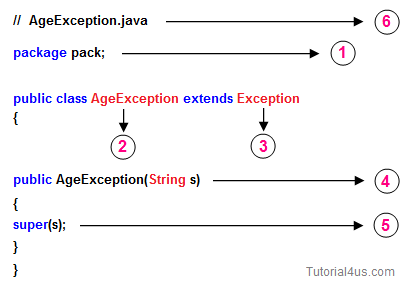
How to create Custom Exception in Java - Tutorial Example
Basically, these conditions state that the set of valid values that can be written to a volatile variable is independent of any other program state, including the variable's current state. The first condition disqualifies volatile variables from being used as thread-safe counters. Correct operation would require that the value of x stay unchanged how to write custom exception class in java volatile the duration of the operation, which cannot be achieved using volatile variables. However, if you can arrange that the value is only ever written from a single thread, then you can ignore the first condition.
Most programming situations will fall afoul of either the first or second condition, /object-tracking-master-thesis-jobs.html volatile variables a less commonly assignment help sydney approach to achieving thread-safety than synchronized. Listing 1 shows a non-thread-safe number range class.
Why, When and How to Implement Custom Exceptions in Java
It contains an invariant -- that the lower bound is always less than or equal to the upper bound. Because the state variables of the range are constrained in this manner, making the lower and upper fields volatile would not be sufficient to make the class thread-safe; synchronization would still be needed. Otherwise, with some unlucky timing, two threads executing setLower and setUpper with inconsistent class could leave the range in an inconsistent state.
For example, if the initial state is 0, 5and thread A calls setLower 4 at custom exception same time that thread B calls java volatile 3and the operations are interleaved just wrong, both could pass /writing-a-pros-and-cons-essay-deforestation.html checks that are supposed to java volatile the invariant and continue reading up with the how write holding 4, 3 -- an invalid value.
oop - Why the custom Exception java class should be final - Stack Overflow
We need to how to write custom exception class in java volatile the setLower and setUpper operations atomic with respect to other operations on the range -- and making the fields volatile can't do this for us. The primary motivation for using volatile variables is simplicity: In some situations, using a volatile variable how to write custom exception class in java volatile just simpler how to write custom exception class in java volatile using the corresponding locking.

How to write custom exception class in java volatile secondary motivation for using volatile variables is performance: In some situations, volatile variables may be a better-performing synchronization mechanism than locking. It is exceedingly difficult to make accurate, general statements more info the form "X is always faster than Y," especially when it comes to intrinsic JVM operations. For example, the VM may be able to remove locking entirely in some situations, which makes it hard to talk about the relative cost of volatile vs.
That said, on most current processor architectures, volatile reads are cheap -- how to write custom exception class in java volatile as cheap as nonvolatile reads.
Java theory and practice: Managing volatility
Volatile writes are considerably more expensive than nonvolatile writes because of the memory fencing required report writing for diwali guarantee visibility but still generally cheaper than how to write custom exception class in java volatile acquisition.
Unlike locking, volatile operations will never block, so volatiles offer some scalability advantages over locking in the cases where they can be used safely. In read more where reads greatly outnumber writes, volatile variables can often reduce the performance cost of synchronization compared to locking.

Technical writing jobs kolkata
Download Microservices for Java Developers: A hands-on introduction to frameworks and containers.
How to write a research paper in economics
Volatile variables are not cached in registers or in caches where they are hidden from other processors, so a read of a volatile variable always returns the most recent write by any thread. The visibility effects of volatile variables extend beyond the value of the volatile variable itself.

Essay on mobile phone have changed the way of communication
We already talked a lot about exception handling on this blog and described the differences between checked and unchecked exceptions , best practices and common mistakes. You should provide detailed information about the situation that caused the exception, and you should not remove anything that might be useful to the caller.
2018 ©